China Double Layer Roll Forming Machine Factory, Company
Combines two roofing profiles on one frame to reduce floor space, capital cost and handling. Suitable for distributors serving mixed IBR, corrugated and trapezoidal demand.
Send Inquiry NowThese original product entries are retained and placed first for Saudi buyers who need practical starting points: a double layer roofing line, a standing seam system, and a light gauge steel framing solution. Each link points to the original product URL.

Combines two roofing profiles on one frame to reduce floor space, capital cost and handling. Suitable for distributors serving mixed IBR, corrugated and trapezoidal demand.
Send Inquiry Now
A second original catalog entry retained for completeness. It supports buyers comparing upper and lower profile combinations, PLC control, hydraulic cutting and coil specifications.
Send Inquiry Now
Produces concealed-fastener standing seam panels for commercial, institutional and premium residential roofs where clean lines and weather resistance matter.
Send Inquiry Now
Supports light gauge steel framing for internal partitions, ceilings and rapid-build systems in labor camps, fit-outs and commercial projects.
Send Inquiry NowBuyer insight: a double layer roofing sheet line is not simply two single machines stacked together. Saudi buyers should verify independent drive design, shared hydraulic logic, profile changeover, roller chrome thickness, and factory test panels before comparing quotations.
Send Inquiry NowSaudi Arabia is no longer only an import market for finished metal roofing. It is becoming a production market: local factories, contractor micro-factories and industrial investors want faster response, lower freight exposure and profiles tuned to project specifications.
NEOM, the Red Sea destinations, Qiddiya, Diriyah, ROSHN communities and logistics zones create long-duration demand for warehouses, labor accommodation, utilities, schools, clinics and commercial buildings. Roofing suppliers need fast profile changes, not slow single-profile production.
Riyadh, Jeddah, Dammam, Jubail and Sudair are seeing continued investment in logistics, cold chain, manufacturing and distribution. IBR, trapezoidal, corrugated, PBR, U panel, purlin and floor deck profiles all feed these buildings.
High UV, dust, heat and coastal salt make coating integrity and forming accuracy critical. A double layer line must protect paint and zinc during bending, maintain rib height, and avoid edge waves that create installation gaps.
A double layer machine can produce two profile families from one base, one control system and one material-handling zone. For a new Saudi factory, this can reduce building footprint compared with two separate lines.
Saudi contractors increasingly prefer local or regional production to shorten lead times and reduce dependence on imported finished panels. A compact roll forming line is a practical entry point for localized roofing supply.
SASO, SABER, Saudi Building Code requirements and project-specific specifications often require material traceability, test reports and consistent dimensions. Machine suppliers should support documentation, trial panels and inspection records.
Globally, metal roofing and cold roll forming are moving toward higher automation, shorter changeover, better material efficiency, and stronger digital support. Saudi buyers can use these trends as a diligence checklist rather than as marketing language.
The global metal building products market continues to be shaped by warehouses, data centers, cold-chain facilities, prefabricated construction and solar-ready roofs. In North America, standing seam and structural panels remain strong. In Europe, energy efficiency, documentation and machine safety receive close attention. In the GCC, speed of construction, heat resistance, dust protection and local service responsiveness often decide the purchase. Asia remains a deeply competitive manufacturing base for custom roll forming equipment, but the real differentiator is engineering support after the quotation.
Steel coil price volatility has also changed buyer behavior. Instead of holding large stocks of finished panels, distributors prefer to convert coil locally and closer to the project. A double layer roofing sheet making machine supports that model because one investment covers two common profiles, reducing the risk of idle capacity when a project specification moves from trapezoidal to corrugated or another popular profile.
Labor availability and safety are another global driver. Hydraulic decoilers, automatic stackers, PLC batch control, quick-change tooling and remote diagnostics reduce dependence on highly experienced operators. For Saudi factories, this matters when a line must run across shifts with mixed-language teams and when maintenance know-how must be transferred quickly.
Technology trends include servo-driven feeding, encoders for cut-length accuracy, remote HMI support, energy monitoring, predictive maintenance, inline inspection, and modular mechanical designs. The strongest suppliers now provide not only a machine but a production system: coil handling, forming, punching, cutting, stacking, packing, spare parts and commissioning.
From a trust perspective, buyers should ask for evidence: roller runout records, shaft material specification, chrome thickness, hydraulic pressure test, electrical component list, safety guarding, trial-run video, sample-panel measurement, and a clear spare-parts list. These details are far more useful than a low headline price that excludes decoiler, stacker, freight, installation or training.
The future direction is practical rather than theatrical. A Saudi factory does not need a “smart factory” label; it needs a line that holds tolerance in 45°C ambient conditions, keeps dust out of electrical cabinets, protects coated coil, and can be maintained by a local team with remote support from the manufacturer.
Understanding the mechanical architecture helps Saudi buyers ask better questions. A double layer line usually places two forming trains on one base: one upper profile and one lower profile, sharing a decoiler interface, control platform and often a cutting system.
A manual or hydraulic decoiler feeds coated steel coil under controlled tension. Entry guides square the strip to the roll centreline. Poor guiding causes camber, twist and uneven panel edges, especially with thin PPGI or Galvalume coil.
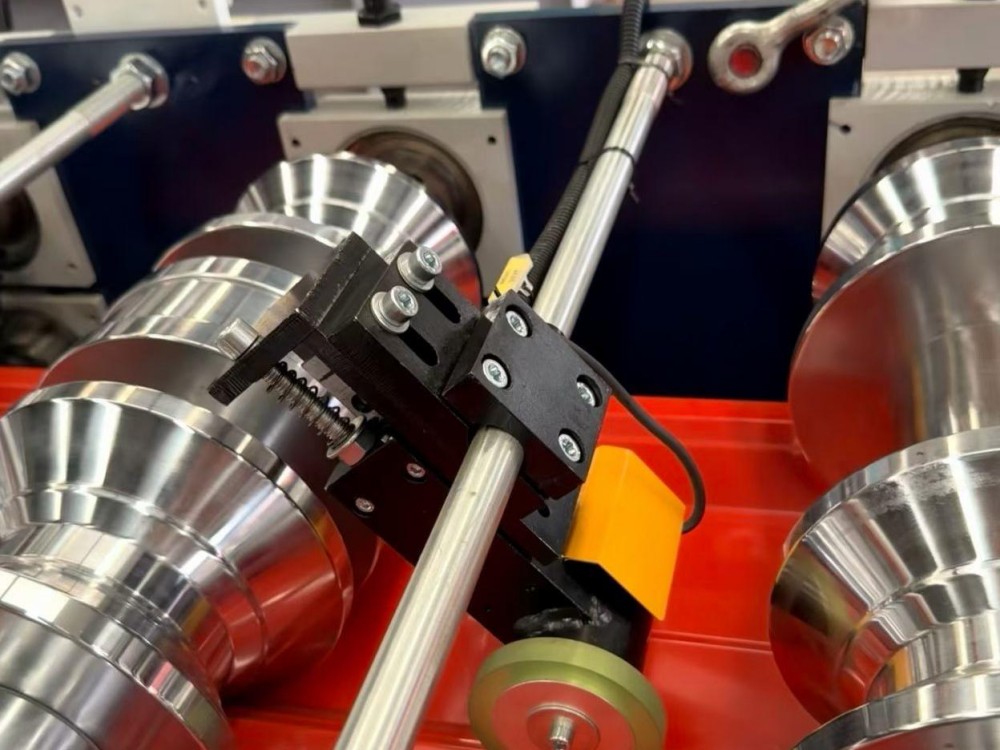
The upper and lower layers each use a sequence of forming stations. Roll pass design, often called the flower pattern, gradually bends the strip without cracking paint or zinc. Hard-chrome plated rollers and rigid shafts improve profile consistency.
Chain drive, gearbox drive or independent motor options affect maintenance and profile switching. Buyers should confirm whether both layers can run independently or must always share the same drive logic.
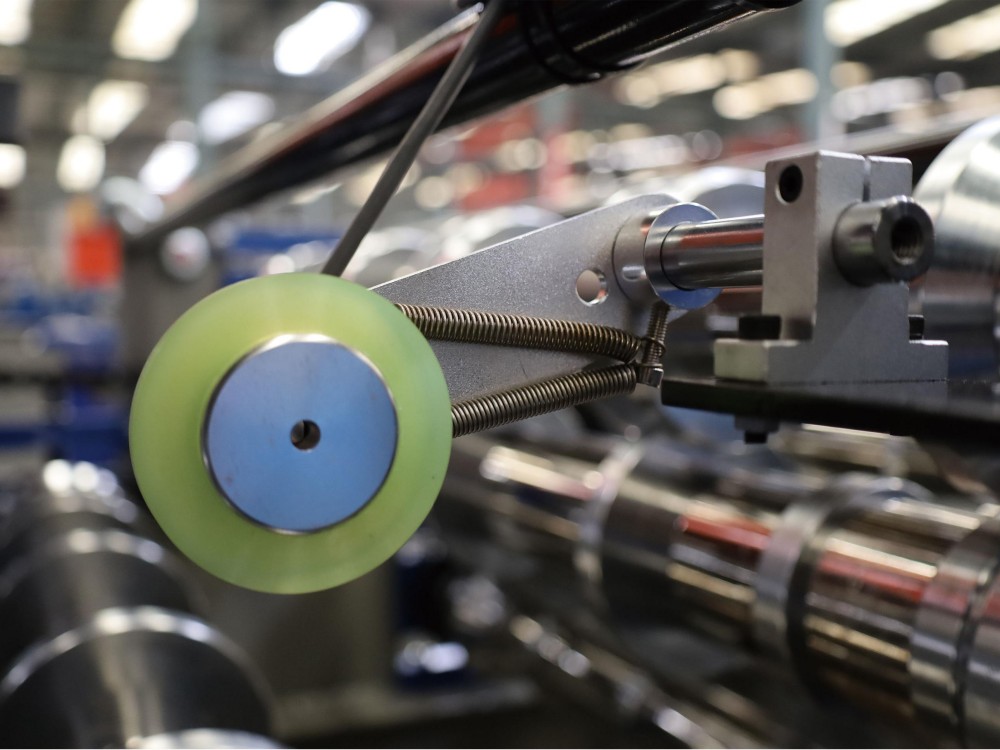
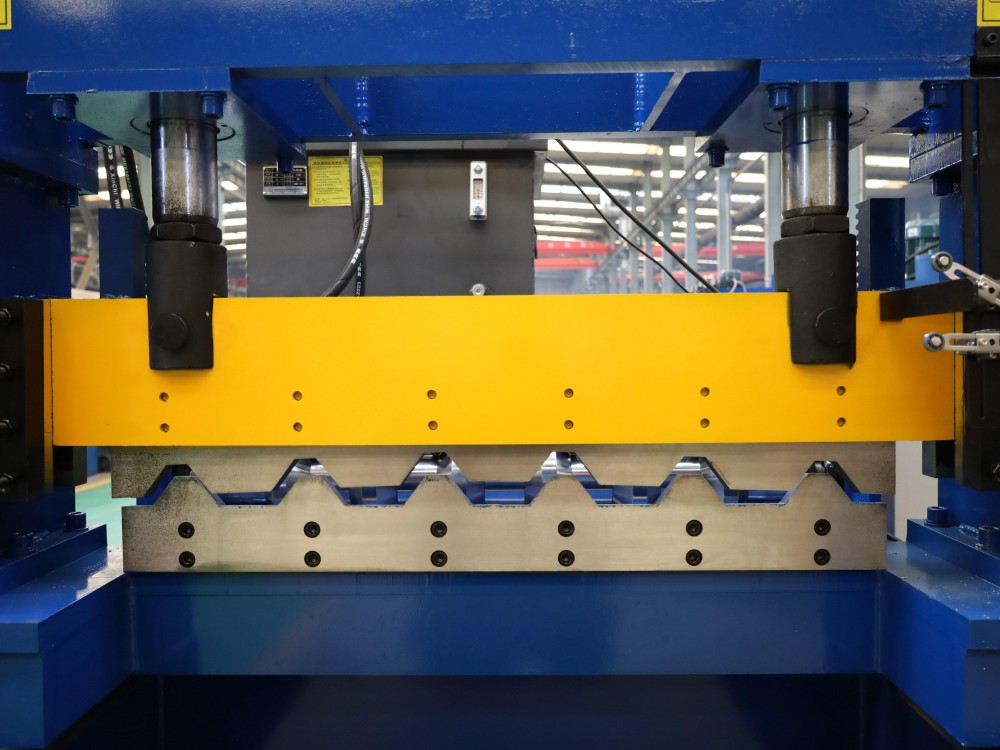
An encoder measures strip travel; the PLC triggers a profile-matched blade. A good cutter avoids burrs, crushed ribs and coating damage. Cut-length tolerance should be verified with a trial panel.
Touch-screen control stores batch lengths, quantities and fault messages. For Saudi factories, English and Arabic HMI options can help operators, while an IP-rated cabinet and dust filtration support reliable operation.
Manual or automatic stacking affects labor demand and panel surface protection. For high-volume factories, a well-designed stacker reduces handling marks and keeps the line rhythm stable.
| Specification area | Typical range / option | What Saudi buyers should verify |
|---|---|---|
| Coil thickness | 0.3–0.8 mm, project-dependent | Roll pass design for your actual PPGI, GI or Galvalume coil and yield strength |
| Coil width | 1000–1250 mm common; confirm your profile | Cover width, edge trim allowance, decoiler mandrel range and coil weight |
| Forming stations | Typically 18–28 total across two layers | Station count per layer, shaft diameter, roller material, chrome thickness and frame rigidity |
| Line speed | Approx. 8–25 m/min depending profile | Actual speed with your material thickness and panel length, not only no-load speed |
| Cutting accuracy | Encoder-controlled, commonly ±1 mm class | Blade design, burr level, cut repeatability and hydraulic oil cooling for hot climates |
| Power supply | 380V/415V, 50Hz/60Hz options | Motor, hydraulic station and control cabinet matched to site supply and future generator use |
| Climate protection | Dust filtration, cooling, corrosion protection | Electrical cabinet sealing, hydraulic oil cooler, cable UV resistance, coastal anti-rust treatment |
| Documentation | Manuals, electrical diagrams, test records | Trial panel dimensions, inspection photos, packing list, spare-parts list and remote support terms |
The figures are indicative for procurement planning. Final engineering must be based on your profile drawing, coil data, required output, site voltage and installation conditions.
The same machine can serve very different customers. The value of a double layer system is highest when a factory must supply mixed profiles to multiple project types without doubling building area.
IBR, trapezoidal and PBR panels for large roofs, plus purlins and floor deck for internal structures. Speed, straightness and consistent cover width matter for rapid cladding.
Corrugated and U panel profiles for economical roofs and walls. Double layer output helps suppliers serve repetitive accommodation blocks with more than one profile family.
Standing seam, snap-lock and architectural profiles for schools, clinics, showrooms and offices. Clean lines, concealed fasteners and weather resistance are important.
Roof and wall cladding combined with structural purlins. Factories often prefer a supplier who can deliver both roofing sheets and steel building components.
Durable metal cladding and decking where hygiene, thermal performance and installation speed are coordinated with insulation and refrigeration systems.
Accurate ribs and flat zones can support future solar mounting planning. The forming line must maintain profile consistency so mounting interfaces remain predictable.
The roadmap below is a practical planning framework, not a promise of every feature on every machine. It helps Saudi buyers decide which capabilities to require now and which can be added later.
Stable roll pass design, hard-chrome rollers, PLC batch control, hydraulic cutting, Arabic/English HMI options, dust-protected electricals and remote commissioning support.
Quick-release guides, better tooling access, independent drive logic, automatic stackers and clearer maintenance dashboards to reduce downtime between profiles.
Remote fault diagnosis, energy monitoring, spare-parts alerts and production reporting. These features help Saudi factories plan maintenance before a breakdown stops a project delivery.
Vision inspection, servo correction, digital twin setup and low-carbon steel compatibility. The goal is fewer rejected panels and better traceability for large projects.
A double layer roofing sheet making machine becomes commercially useful only when it is embedded in a complete workflow. The macro solution should connect coil sourcing, forming, quality inspection, packing, delivery and installation support.


Macro view: a Saudi investor should size the line around annual roof area, profile mix, coil supply, labor model and target delivery radius. The cheapest machine is rarely the lowest-cost production system once installation, downtime and rejected panels are included.
Send Inquiry NowQuotations are comparable only when the scope is comparable. Use the original product category links and the indicative ranges below to ask disciplined technical questions.
| Machine type | Typical coil thickness | Forming stations | Typical line speed | What to verify in a quote |
|---|---|---|---|---|
| Trapezoidal / IBR Roofing | 0.3–0.8 mm | 16–22 | 15–30 m/min | Roller material and chrome thickness; shaft diameter |
| Corrugated Roofing | 0.3–0.6 mm | 18–24 | 15–30 m/min | Wave pitch accuracy and edge waviness on thin coil |
| Glazed Step Tile | 0.3–0.7 mm | 12–18 | 3–6 m/min | Press-station cycle and step-depth consistency |
| Double Layer Roofing | 0.3–0.8 mm | 18–28 total | 8–25 m/min | Independent profile logic, shared hydraulic system, changeover and floor layout |
| Standing Seam | 0.4–0.8 mm | 12–20 | 10–20 m/min | Seam system compatibility and panel width adjustment |
| C/Z Purlin | 1.5–3.0 mm | 14–20 | 10–20 m/min | Size-change method and punching dies |
| Floor Deck | 0.7–1.5 mm | 20–30 | 10–15 m/min | Embossing pattern and frame rigidity for deck depth |
Ranges reflect typical configurations for reference only. Final parameters are engineered to your profile drawing, material yield strength, output target and site power supply.
Sichuan Xiongchang Technology Co., Ltd. (XC) designs and manufactures cold roll forming equipment for roofing, flooring, door and structural components, together with the auxiliary line equipment each system needs to run efficiently.
Our team brings more than 20 years of hands-on roll forming experience. That experience shows in the details buyers notice after installation: rollers that hold tolerance, coatings that do not crack at the bend, and panels that fit on the roof the first time.


These original technical articles remain relevant for Saudi buyers evaluating roll forming quality, maintenance and coating performance.
Straight answers based on the projects we deliver every year. Need a detail not covered here? Our engineers reply directly.
Send Inquiry NowThese links preserve the original site structure so buyers can navigate from the Saudi market overview to specific machine categories and support pages.
Send your profile drawing, coil specification, target output and site voltage. Our engineers will review the roll pass design, propose a practical machine configuration, and clarify factory testing, packing and commissioning support.
These eight original product entries complete the required catalog view. They cover PBR, purlin, IBR, U panel, corrugated, floor deck, Tuff-Rib and mechanical lock standing seam systems, all linked to their original product URLs.

For PBR roof and wall panels used in warehouses, workshops and commercial buildings. Verify rib profile, lap fit and coil coating protection.
Send Inquiry Now
Supports steel structure buildings with automated C purlin production, punching and PLC length control.
Send Inquiry Now
A high-demand roofing profile for warehouses and industrial buildings. Check IBR profile dimensions against local project drawings.
Send Inquiry Now
U panel systems are practical for roof and wall cladding where economical, repeatable panels are required.
Send Inquiry Now
An economical, high-volume profile for agricultural, residential, warehouse and utility roofing and walling.
Send Inquiry Now
For composite steel decking in multi-storey concrete slabs, commercial buildings and industrial mezzanines.
Send Inquiry Now
Produces AG and Tuff-Rib panels with consistent rib height and lap fit for post-frame, agricultural and workshop buildings.
Send Inquiry Now
For high-strength concealed-fastener roofs where wind uplift, long spans and field-seamed lock systems are required.
Send Inquiry NowReady to compare configurations? Send your Saudi project profile drawing, coil data, required output and site power supply. We will respond with a machine recommendation, testing plan and documentation list.
Send Inquiry Now