
Eight ODM Roll Forming Lines for Glazed-Tile and Metal-Roofing Producers
This first product showcase preserves the original product images and destination URLs supplied for this glazed tile production line series. Each machine family can be reviewed as a standalone line or as part of a complete roofing production cell, with profile tooling, electrical configuration and acceptance documentation matched to the buyer’s market.








ODM Glazed Tile Lines Are an Engineering, Compliance and Branding Decision
A glazed tile production line is not a commodity purchase. It is a production asset that determines whether a distributor, roofing contractor or private-label manufacturer can deliver consistent step profiles, protect coated steel surfaces, meet local electrical expectations and build a recognizable brand. That is why serious buyers compare ODM glazed tile production line manufacturers and companies on engineering depth, acceptance evidence and localized support—not only on initial price.
Prepared by XC’s cold roll forming engineering and export team
Sichuan Xiongchang Technology Co., Ltd. (XC) designs and manufactures cold roll forming equipment for roofing, flooring, door, structural and light gauge steel applications, together with the auxiliary line equipment each system needs to run efficiently. Our team brings more than 20 years of hands-on roll forming experience, supported by a 50,000 m² production base, 1,000+ cooperative customers worldwide and a team of 2,000+ engineering and production members.
For glazed tile buyers, that experience matters in the details that appear after installation: rollers that hold tolerance, coatings that resist cracking at the bend, step presses that repeat cleanly, and panels that fit together on site.
Explore Glazed Tile Roll Forming MachinesYears of roll forming industry experience
Factory area for machining and assembly
Cooperative customers worldwide
Team members across engineering and production
Profile Ownership for ODM Buyers
ODM manufacturing allows a buyer to develop a market-specific glazed tile profile, brand the line, localize manuals and packaging, and build a product portfolio without starting from a blank engineering sheet.
Factory Acceptance Evidence
Every line is assembled and test-run in our factory with coil that matches the buyer’s specification. Sample panels are measured against the drawing, and a trial-run video plus inspection photos are shared before packing.
Built in China, Tuned for Your Market
Local profiles, local voltages, local coil standards and local language needs are considered before the design is frozen. The objective is a production line that behaves like a local asset, not an imported experiment.
From a Single Glazed Tile Machine to a Bankable Production Cell
Glazed tile roll forming lines combine continuous forming with an intermittent step-press operation. The forming stations create the tile ribs and edge geometry; the hydraulic press station creates the distinctive step that gives the panel its clay-tile appearance. Because these functions must remain synchronized, line architecture matters as much as individual component quality.
What an ODM glazed tile line should deliver
An effective production cell should take coated steel coil from the decoiler, guide it accurately, form the profile progressively, press the step pattern, cut to length and deliver panels that can be bundled without surface damage. A PLC and HMI should store batch lengths, quantities and operating parameters so that changeovers do not depend on operator memory.
- Profile-to-machine design from drawing, sample or photo
- Roll pass design that protects zinc and paint coatings at bend zones
- Hard-chrome plated forming rollers and rigid frame construction
- Hydraulic step press synchronized with PLC control
- Encoder-controlled cutting with typical ±1 mm length accuracy
- Test-run with matching coil and approval before shipment
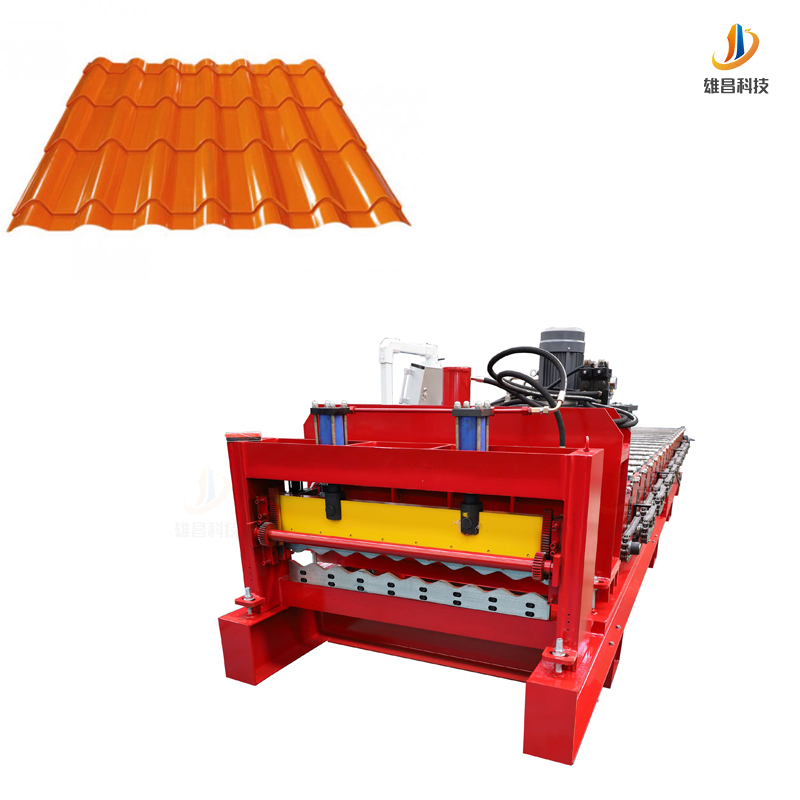
Decoiler & Coil Feeding
Manual or hydraulic decoiler feeds coil under controlled tension. Stable unwinding prevents strip wander, camber and twisted panels.
Entry Guiding
Adjustable entry guides square the strip to the roll centreline before the first pass, protecting profile straightness.
Progressive Forming
Each station bends the strip a few degrees at a time. The flower pattern spreads strain evenly across the section.
Hydraulic Step Press
The glazed tile step is created with a synchronized press station so step depth and tile-line definition remain uniform.
Post-Cutting
An encoder measures strip travel and the PLC triggers a profile-matched blade for clean cuts within typical ±1 mm tolerance.
PLC / HMI Control
A touch-screen HMI stores batch lengths, monitors faults and supports multi-language operation for local operators.
Equipment selection should follow the buyer’s output target, local profile, coil thickness and yield strength. Indicative ranges are a starting point; final parameters are engineered to the confirmed profile and material specification.
Where Glazed Tile Production Lines Win Business
Global demand for metal roofing continues to be shaped by urbanization, labor availability, construction speed, insurance-driven durability requirements and the aesthetic expectations of residential and hospitality projects. Glazed tile profiles sit at the premium end of that market because they combine the visual rhythm of traditional roof tiles with the installation speed and dimensional consistency of roll formed steel.
Southeast Asia
High rainfall, coastal humidity and fast-growing residential markets reward roof profiles that drain efficiently, install quickly and can be produced close to the project. Local profile matching and 220V or 380V power configurations are common requirements.
Middle East
Heat, UV exposure and large-scale developments place a premium on stable production, dust-protected electricals, efficient cooling and clear maintenance routines. Buyers frequently specify 380V or 415V systems and high-output batch planning.
Africa
Housing growth and infrastructure programs create demand for accessible metal roofing production. Import logistics, spare-parts planning and remote commissioning support are often as important as the machine’s headline speed.
Latin America
Spanish-language documentation, 220V or 440V supply, 60Hz options and regional profile preferences are practical localization issues. A supplier that can tune the line to local building practice reduces startup friction.
Europe & North America
Premium residential and architectural projects demand tight tolerances, reliable surface finish and clear technical files. Compliance documentation, safety guarding, panel samples and traceable inspection records become central to supplier selection.
Private-Label Distributors
Distributors and roofing brands use ODM lines to control profile supply, color programs, packaging, lead times and after-sales service. The production line becomes part of the brand promise, not merely a factory asset.
In commercial terms, the strongest ODM suppliers are not simply exporters. They help buyers compare total cost of ownership: freight, foundation work, coil yield, energy consumption, changeover time, operator training, spare parts and long-term technical support. XC’s global supply model is built around that reality—built in China, tuned for your market, with commissioning support worldwide.
Engineering for the Destination, Not Just the Factory
Localization is more than translating a manual. It includes electrical design, safety logic, operator interface, profile tolerances, documentation, spare-parts strategy and a clear route for installation support. For glazed tile lines, it also includes matching the visual proportions that the local market recognizes as a premium roof tile.
Power Supply Configuration
Motors, hydraulic stations and control cabinets are configured to your site voltage and frequency, for example 220V, 380V, 415V or 440V at 50Hz or 60Hz, with HMI language options for operators.
Documentation & Training
English manuals and electrical diagrams are supplied, together with remote video guidance for installation and commissioning. On-site engineer service is available on request.
Safety & Compliance Review
Guard packages, emergency stops, lockout points and risk-reduction measures can be reviewed against the destination market. Where CE, UKCA, UL, CSA or other local requirements apply, the buyer’s authority should confirm final applicability before order release.
Spare Parts & Service
Spare parts supply covers blades, bearings, rollers and electrical components. Preventive maintenance planning helps buyers protect uptime after the line enters routine production.
Regional Profile Matching
Most XC machines are built to order. Engineers develop the roll pass design—the flower pattern—from your drawing or sample, so regional profiles such as IBR, Tuff-Rib, Klip-Lok style or Spanish-style tiles can be matched closely. For glazed tiles, step depth, shadow line, cover width and overlap geometry are reviewed together rather than in isolation.
Export Packing & Startup Planning
Long shafts, precision rollers and control cabinets require export-grade protection and lifting planning. Documentation, packing lists and installation sequencing are prepared so the receiving team can organize foundations, power, compressed air and coil storage before the line arrives.
Where Glazed Tile Panels Create Commercial Value
Glazed tile panels are selected when a project needs the visual richness of a pitched tile roof without the weight, breakage and labor intensity associated with traditional tiles. The strongest applications combine aesthetic requirements with a need for repeatable production, fast installation and dependable color consistency.
Premium Residential & Villa Roofing
Deep shadow lines, controlled step depth and consistent color make glazed tile panels suitable for villas, gated communities and premium housing. Local wind, rain and thermal movement requirements should be reviewed with the fixing system.
Hospitality & Resort Projects
Hotels, resorts and cultural facilities often need a roof appearance that supports the architectural concept. ODM buyers can build a profile and color program that differentiates their offer while retaining predictable production quality.
Urban Renovation & Infill
Renovation projects may need shorter production runs, matched colors and careful handling around existing structures. A PLC-controlled line with saved batch parameters helps reduce setup time and material waste.
Private-Label Roofing Supply
Distributors can use ODM production to control profile names, packaging, samples, color ranges and technical literature. The line becomes a platform for brand-building rather than a one-off equipment purchase.
Coastal & High-Humidity Markets
Corrosion protection, drainage details and fixing compatibility are critical in coastal environments. Buyers should specify coil coating systems and inspection routines appropriate to the project exposure.
Commercial Accents & Canopies
Glazed tile profiles can also support entrance canopies, feature roofs and mixed-material facades where a tile rhythm is desired. Designers should confirm panel support, fixings and weather detailing with the project engineer.
XC’s roll forming expertise also extends beyond roofing into architecture and building materials, automobile manufacturing, home appliances and kitchen and bath, transportation, new energy, and furniture and office equipment. That cross-industry experience strengthens the engineering discipline applied to glazed tile production lines.
From Mechanical Reliability to Digital Production Intelligence
The next stage of competition among ODM glazed tile production line manufacturers will not be decided by frame weight alone. It will be shaped by quick-change tooling, servo-assisted setup, inspection data, remote diagnostics and the ability to integrate a production line into a buyer’s commercial workflow.
Modular, Quick-Change Line Architecture
Cassette-style tooling and faster changeover logic can help buyers serve multiple glazed tile profiles with one production cell. The commercial benefit is smaller batch sizes without proportional increases in downtime.
Closed-Loop Quality Monitoring
Vision inspection, laser measurement and inline parameter feedback can move quality control from end-of-line sampling toward real-time profile verification. For coated steel, surface-defect detection is especially valuable.
IoT-Ready Service & Remote Support
Machine data can support preventive maintenance, fault diagnosis and operator guidance. Remote support reduces travel time and helps overseas buyers resolve routine issues with factory engineering teams.
Lower-Carbon Materials & Efficient Production
As coated steel supply chains focus on lower-carbon products, forming lines must protect surface quality while reducing energy and scrap. Efficient roll pass design, accurate cutting and optimized line speed all contribute to material yield.
For buyers, the practical roadmap is to prepare data now: profile drawings, coil certificates, target output, local voltage, available floor space, operator skill level and maintenance resources. A supplier that can convert those inputs into a documented line configuration is better positioned to support the asset over its full life cycle.
Compare Roll Forming Machines Before You Request a Quote
Quotes are only comparable when the specifications are. Use these indicative ranges and the key check for each machine type to judge any supplier’s offer, including ours. The final configuration must always be engineered to your confirmed profile, material yield strength, output target and site power supply.
| Machine Type | Typical Coil Thickness | Forming Stations | Typical Line Speed | What to Verify in a Quote |
|---|---|---|---|---|
| Trapezoidal / IBR Roofing | 0.3–0.8 mm | 16–22 | 15–30 m/min | Roller material and chrome thickness; shaft diameter |
| Corrugated Roofing | 0.3–0.6 mm | 18–24 | 15–30 m/min | Wave pitch accuracy and edge waviness on thin coil |
| Glazed Step Tile | 0.3–0.7 mm | 12–18 | 3–6 m/min | Press-station cycle and step-depth consistency |
| Standing Seam | 0.4–0.8 mm | 12–20 | 10–20 m/min | Seam system compatibility and panel width adjustment |
| C/Z Purlin | 1.5–3.0 mm | 14–20 | 10–20 m/min | Size-change method and punching dies |
| Floor Deck | 0.7–1.5 mm | 20–30 | 10–15 m/min | Embossing pattern and frame rigidity for deck depth |
Ranges reflect typical configurations for reference only. For glazed tile lines, the step-press cycle, profile geometry and coating protection requirements may define the final output more strongly than the nominal line speed.
From Profile Drawing to First Panel
A transparent five-step process, so overseas buyers know exactly what happens and when. The objective is not simply to ship a machine, but to deliver a line that can be installed, operated and maintained with confidence.
Profile & Coil Review
Send your drawing, sample or photo plus coil data. Engineers check that the profile can be formed and flag any risks.
Roll Pass Design & Proposal
You receive the station count, roller material, drive and cutting system, power configuration and a confirmed schedule.
Manufacturing & QC
Frames, shafts and rollers are machined and assembled in-house, with inspection at each critical stage.
Trial Run & Acceptance
The line runs with coil matching your specification. Samples are measured, and a video report is shared for approval.
Shipping & Commissioning
Export packing, documentation, then remote or on-site installation and operator training.
Field Knowledge from Our Engineers
Useful production knowledge often sits outside the quotation. These engineering notes reflect the issues buyers actually face after installation—bearing runout, coating cracks at bend zones and roll forming choices that affect long-term output.

Roll Forming Advantages and Applications
Why continuous roll forming beats press braking for long, consistent profiles, and which industries gain the most from it.

Bearing Damage in Multi-Stand Roll Forming Stations: The Hidden Cause of Roll Runout
Six root causes of bearing failure, the diagnostic checks to run first, and how they show up as strip tracking loss and coating defects.

Zinc & Color Coating Cracking at Bending Zones: Root Causes and Fixes
From bend radius to roll pass design, this article explains what makes coatings crack at the bend line and how coating-safe forming prevents it.
Questions Overseas Buyers Ask Us Most
Straight answers based on the projects we deliver every year. These questions also help procurement teams compare ODM glazed tile production line manufacturers and companies on the criteria that matter after installation.
What information do I need to send for an accurate roll forming machine proposal?
Send your profile drawing or a photo of a sample panel, material type (PPGI, GI, Galvalume or black steel), thickness range, yield strength, coil width, required output per shift, and your local voltage and frequency. With these details our engineers can define the number of forming stations, roller material, cutting system and motor power.
Can XC build a roll forming machine for a local or non-standard profile?
Yes. Most XC machines are built to order. Our engineers develop the roll pass design (flower pattern) from your drawing or sample, so regional profiles such as IBR, Tuff-Rib, Klip-Lok style or Spanish-style tiles can be matched closely.
How is machine quality verified before shipment?
Every line is assembled and test-run in our factory with coil that matches your specification. Sample panels are measured against your drawing, and a trial-run video plus inspection photos are shared for your approval before packing.
What is the typical lead time for a roll forming machine?
Standard roofing sheet lines are commonly ready within 30 to 45 working days after drawing confirmation. Purlin, floor deck, double layer and fully customized lines may take longer. The confirmed schedule is stated in each proposal.
What after-sales support does XC provide to overseas buyers?
XC provides English manuals and electrical diagrams, remote video guidance for installation and commissioning, on-site engineer service on request, and spare parts supply such as blades, bearings and electrical components.
Can machines be configured for my local power supply?
Yes. Motors, hydraulic stations and control cabinets are configured to your site voltage and frequency, for example 220V, 380V, 415V or 440V at 50Hz or 60Hz, with HMI language options for operators.
What does ODM mean for a glazed tile production line?
ODM means the manufacturer develops the line and profile solution around the buyer’s market and brand requirements. That can include profile development, machine configuration, electrical localization, documentation, packaging language, sample panels and private-label presentation. The buyer should still verify who controls the roll pass design, machining and factory acceptance test.
Which coil materials are suitable for glazed tile panels?
PPGI, GI and Galvalume coils are commonly used, with thickness and coating selected for the project environment. The final material window should be confirmed against the roll pass design, step-press tonnage and local corrosion expectations. Coating flexibility at the bend line is a critical review point.
How should a buyer evaluate glazed tile line output?
Evaluate output using real panel length, step cycle, changeover time and scrap rate—not nominal line speed alone. A glazed tile line with a synchronized hydraulic step press may run at a different pace from a simple trapezoidal roofing line. The proposal should explain the assumptions behind the output figure.
What spare parts and training should be planned at startup?
Plan for cutting blades, bearings, selected electrical components and routine wear parts, together with operator training on setup, coil loading, step-press adjustment, cut-length control and daily inspection. A preventive maintenance schedule should be agreed before the line enters production.
Explore the Wider XC Roll Forming Range
Glazed tile production is often part of a larger metal roofing and structural component business. These machine families preserve the original category navigation supplied for this product series.
Planning Your Next Glazed Tile Forming Line?
Request the technical catalog with machine layouts, profile options and specification guidance. For a faster proposal, send your glazed tile drawing or sample photo, coil thickness, yield strength, target output, local voltage and destination market.
Sichuan Xiongchang Technology Co., Ltd. (XC)
Sichuan, China · Cold roll forming systems for roofing, flooring, structural and light gauge steel profiles.
Our engineers reply directly with technical questions, profile review notes and the information needed to compare an ODM line against your local market requirements.
Eight More Product Solutions from the Given Glazed Tile Line Series
This final showcase preserves the second set of original product images and destination URLs. Together with the first eight products above, it completes the 16-item series supplied for this page while supporting buyers who are building a broader metal roofing and structural production portfolio.







