
ODM Automated Roll Forming Solutions Company & Companies
An engineering-led buyer’s guide to automated roll forming solutions companies, custom cold roll forming lines, factory acceptance testing, China supply-chain resilience, localized support, and compliance assurance for roofing, standing seam, purlin, floor deck, and light gauge steel profiles.
Eight ODM automated roll forming solutions for core metal profiles
The machine families below are the most requested starting points for distributors, roofing factories, steel structure suppliers, light gauge steel framers, and industrial panel producers. Each line can be engineered around your profile drawing, coil specification, output target, local voltage, and documentation requirements. Product URLs are retained so buyers can compare the original ODM product pages directly.

For post-frame, agricultural, and commercial roof and wall panels where rib height, lap fit, and coating protection matter.
ODM Tuff rib panel(AG Panel) forming machine Company, Companies

One line for C and Z purlins with quick size changeover, pre-punching options, and steel-building project flexibility.
Custom C Z Interchangeable Purlin Machine Factories, Companies

Super series stud and track production for LGS framing, with stable dimensions and automation matched to factory workflow.
ODM Super Series Light Gauge Steel Roll Forming Machine (Stud & Track Roll Former) Manufacturers, Company

LGS framing U-track line for drywall, ceiling, and light steel structural applications requiring repeatable hole pitch.
China LGS framing U track Roll Forming machine Company, Companies

Industrial IBR sheet forming for metal roofing factories, with profile accuracy and high-volume output priorities.
China Industrial IBR Sheet Forming Machine for Metal Roofing Factories, Companies

Metal C-stud roll forming for partition, ceiling, and light gauge steel systems with PLC-controlled cutting.
China Metal C Stud Roll Forming Machine Manufacturer, Companies

U-panel roofing profile production for exposed-fastener roof and wall cladding, configured to local profile conventions.
ODM U panel roofing roll former Factories, Company

Floor deck roll forming with embossing, heavy-duty frames, and profile-matched cutting for composite concrete slabs.
Custom Floor Deck roll forming machine Manufacturer, Factory
What a true ODM automated roll forming solutions company should deliver
In cold roll forming, ODM is not a logo on a machine. It is a transfer of engineering responsibility across profile definition, strip width, flat pattern, roll pass design, station count, shaft and bearing selection, hydraulic cutting, PLC logic, safety, documentation, factory testing, and commissioning.
Buyers searching for an ODM automated roll forming solutions company usually fit four profiles: building-material distributors who need reliable roof and wall panel supply; contractors who want to control quality and lead time; light gauge steel framers who need accurate studs, tracks, and trusses; and industrial manufacturers producing purlins, floor deck, solar mounting sections, or special profiles. A useful proposal must answer each of these intents with specifications, test evidence, and a support plan—not adjectives alone.
One of the most overlooked causes of poor panel quality is the gap between a profile drawing and the forming flower pattern. A drawing shows the finished section; the flower pattern defines every intermediate bend. If strain is uneven, the coil can edge-wave, twist, flare, or crack coating even when the roll diameters appear correct. XC’s engineering team develops the roll pass design from your drawing, sample, or photo, then checks material yield strength, coil width, thickness range, and coating type before fixing the machine configuration.
Sichuan Xiongchang Technology Co., Ltd. (XC) designs and manufactures cold roll forming equipment for roofing, flooring, door and structural components, together with auxiliary line equipment. The company brings more than 20 years of hands-on roll forming experience, a 50,000 m² manufacturing base, in-house machining and assembly, and a team of more than 2,000 people serving over 1,000 cooperative customers worldwide. That experience matters after installation: rollers that hold tolerance, coatings that survive the bend, and panels that fit on site the first time.
Technical review note: this guide is written from the perspective of XC’s roll forming engineering and export support teams. It reflects the information normally requested in real ODM projects: profile drawings, coil data, output targets, voltage and frequency, local building requirements, documentation scope, and factory acceptance criteria.

Years of roll forming industry experience
Factory area for machining and assembly
Cooperative customers worldwide
Team members across engineering and production
Profile and coil review
Engineers verify material type, thickness, yield strength, coil width, coating, and intended use before quoting a line.
Roll pass design ownership
The flower pattern controls strain distribution, springback, edge wave risk, and coating integrity at every station.
Automation integration
PLC, HMI, encoder length control, hydraulic cutting, and safety logic are configured for operator usability.
Acceptance evidence
Sample panels, measured dimensions, photos, and trial-run video are shared before shipment balance and packing.
Typical engineering workload in a custom ODM line
Exact allocation varies by profile, material, automation scope, and documentation. The chart shows where buyers should focus technical review before approving a design.
From profile drawing to first production panel
A transparent ODM workflow reduces surprises. Each stage below should produce evidence that the next stage can use, so that the final machine is not judged only by appearance but by measured panels, stable production, and safe operation.
Profile, coil, and code review
Send a profile drawing or sample photo, material type, thickness range, yield strength, coil width, required output per shift, local voltage and frequency, and any applicable building code or documentation requirements.
Roll pass design and proposal
Engineers define the flower pattern, bend allowance, springback allowance, station count, roller material, shaft diameter, drive power, cutting method, and automation scope. The confirmed schedule is stated in the proposal.
In-house machining and assembly
Frames, shafts, rollers, hydraulic stations, and control cabinets are built and inspected in-house. Critical dimensions are checked before assembly and again after alignment.
Factory acceptance test
Every line is assembled and test-run with coil that matches the buyer’s specification. Sample panels are measured against the profile drawing, and a trial-run video plus inspection photos are shared for approval.
Automation and operator experience
The PLC and HMI store batch lengths, quantities, and production parameters. Encoder-controlled cutting supports repeatable length tolerance, while fault messages help operators diagnose issues quickly.
Shipping and commissioning
Export packing, English manuals, electrical diagrams, and spare-parts recommendations are prepared. Remote video guidance or on-site engineer service is arranged according to project scope.
Technology roadmap: from automated forming to connected production cells
The next competitive step is not simply faster forming. It is lower changeover time, earlier defect detection, better operator support, and stronger traceability from coil to finished panel.
Servo-driven setup and recipes
Digital recipe changeover reduces manual adjustment, shortens batch time, and makes multi-profile production more predictable.
Inline metrology and correction
Laser or vision measurement can feed profile dimensions back to the line, helping operators catch drift before scrap accumulates.
Condition monitoring
Vibration, temperature, hydraulic pressure, and motor current data can support predictive maintenance and reduce unplanned downtime.
Digital twin and robotic logistics
Simulation, automated stacking, and line-side robotics can improve labor productivity in high-volume roofing and framing factories.
Compare automated roll forming machines before you request a quote
Quotes are only comparable when specifications are comparable. Use the indicative ranges below to ask better questions of any supplier, including XC.
| Machine type | Typical coil thickness | Forming stations | Typical line speed | What to verify in a quote |
|---|---|---|---|---|
| Trapezoidal / IBR roofing | 0.3–0.8 mm | 16–22 | 15–30 m/min | Roller material and chrome thickness; shaft diameter; edge-wave control |
| Corrugated roofing | 0.3–0.6 mm | 18–24 | 15–30 m/min | Wave-pitch accuracy and edge stability on thin coil |
| Glazed step tile | 0.3–0.7 mm | 12–18 | 3–6 m/min | Press-station cycle and step-depth consistency |
| Standing seam | 0.4–0.8 mm | 12–20 | 10–20 m/min | Seam-system compatibility and panel-width adjustment |
| C/Z purlin | 1.5–3.0 mm | 14–20 | 10–20 m/min | Size-change method, punching dies, and cut-off rigidity |
| Floor deck | 0.7–1.5 mm | 20–30 | 10–15 m/min | Embossing pattern and frame rigidity for deck depth |
Ranges reflect typical XC configurations for reference only. Final parameters are engineered to your profile drawing, material yield strength, output target, and site power supply. For light gauge steel machines, see light gauge steel roll forming machine manufacturer information.
How ODM roll forming lines adapt to local market conditions
The same machine concept can perform very differently in different markets because profile conventions, coil supply, building codes, labor availability, climate, and installation practice all change. Localized application engineering is therefore a search-intent signal, not a marketing phrase.
North America: post-frame and AG panels
Buyers often request Tuff-Rib, PBR, AG panel, and nail-strip standing seam profiles. Line design must respect local panel conventions, lap details, and contractor installation habits.
Europe: architectural standing seam
Projects may require concealed-fastener standing seam, glazed tile, and roof renovation profiles, with documentation prepared for local code review and project-specific compliance checks.
Australia and New Zealand: IBR and corrugated
High wind uplift, coastal exposure, and familiar roof profiles influence machine specification. Seam systems and fixing details should be verified against local project requirements.
Middle East and Africa: industrial roofing
Factories often prioritize output, heat resistance, dust tolerance, and stable operation on 380V or 415V supply. Heavy-duty frames and accessible maintenance points are valuable.
Southeast Asia: light gauge steel framing
Compact factories often need C-stud, U-track, and truss profiles with simple operation, fast changeover, and voltage configurations matched to local power.
Latin America: roofing distributors
Double-layer roofing machines, glazed tile lines, and distributor-friendly layouts help suppliers serve mixed profile demand while controlling floor space and capital cost.
Six industries supported by XC roll forming lines

Architecture and building materials
Roofing sheets, wall cladding, standing seam panels, floor decking, and C/Z purlins for warehouses, residential projects, and steel buildings.

Automobile manufacturing
Structural rails, door frame sections, and reinforcement beams where repeatable cross-sections and length tolerance feed automated assembly.

Home appliances, kitchen and bath
Appliance side panels, cabinet frames, and trim profiles formed from pre-painted or stainless coil, where surface protection is critical.

Transportation
Container panels, truck body sections, railway profiles, and guardrails—long, heavy-gauge parts requiring rigid stands and accurate cut-off.

New energy
Solar PV mounting rails, strut channels, and support brackets benefit from inline punching, high-volume output, and fast size changeover.

Furniture and office equipment
Shelving uprights, racking beams, cabinet frames, and partition studs require consistent hole pitch and straightness for safe site assembly.
China factory supply-chain resilience and efficiency advantages
For overseas buyers, China’s roll forming supply chain is not only about cost. Its real advantage is the depth of machining, motors, hydraulics, controls, tooling, and export logistics available within a mature industrial cluster—when the supplier manages quality and schedule properly.
In-house machining and assembly
Machining, frame fabrication, roller production, assembly, electrical build, and testing under one roof reduce coordination risk and protect delivery schedules.
Modular supply and BOM control
A mature component ecosystem shortens lead times for motors, gearboxes, PLCs, hydraulics, bearings, and electrical parts when specifications are confirmed early.
Quality gates and traceability
Incoming material checks, machining inspection, assembly alignment, electrical testing, and trial-run approval create a documented path from drawing to shipment.
Export packing and schedule control
Heavy-duty export packing, consolidated documentation, and pre-shipment inspection help protect long ocean freight and reduce installation delays.
 Multi-profile capability across roofing, purlin, deck, and framing
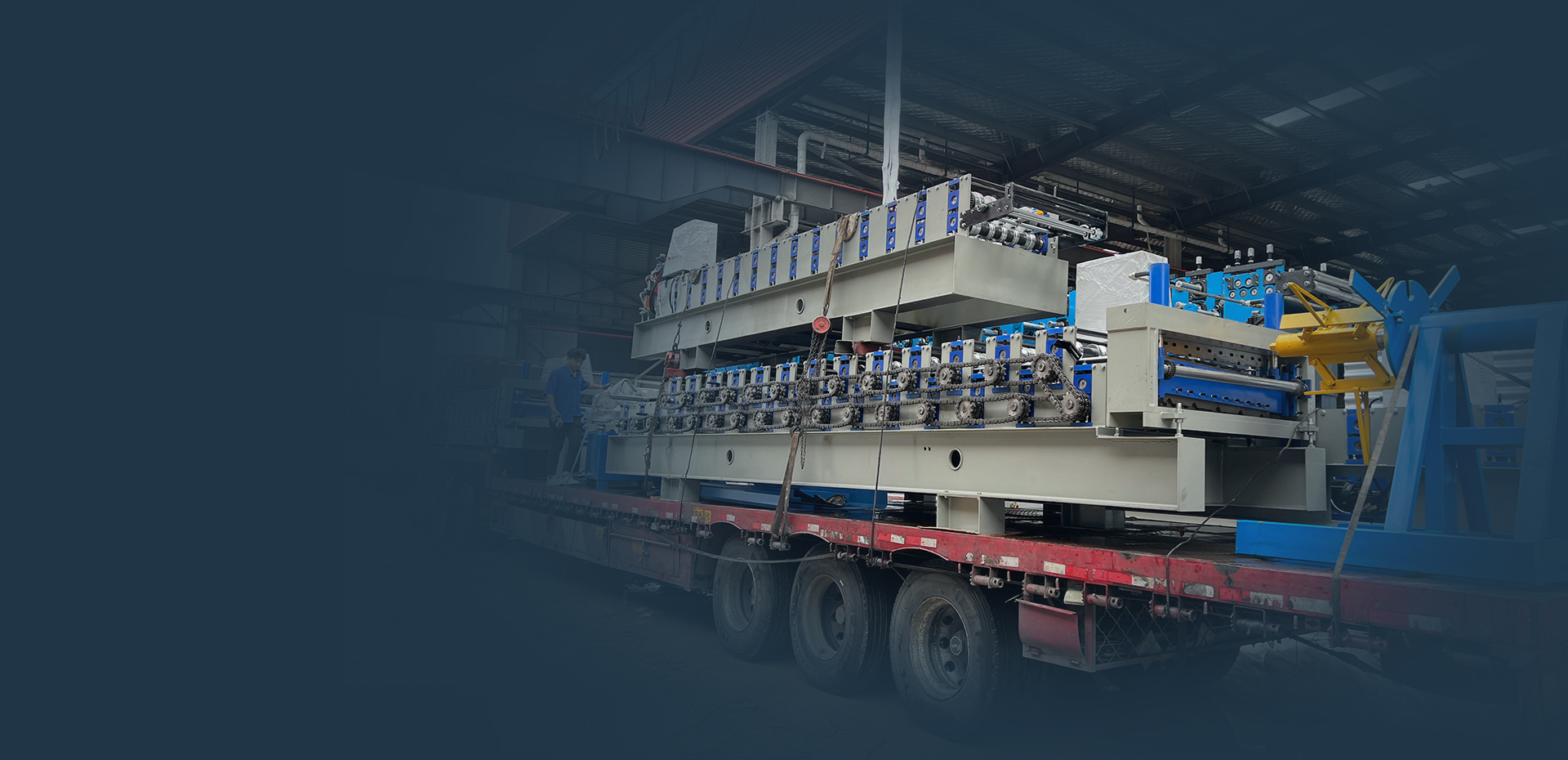 Export-ready lines and global commissioning support
 Engineering and assembly teams working on a customized line
 Equipment supply, after-sales support, and spare-parts planning
A resilient supply chain still requires buyer discipline: freeze the profile drawing, confirm coil data, settle voltage and frequency, approve documentation scope, and witness the factory acceptance test. When those inputs are clear, China-based manufacturing can deliver strong schedule performance and engineering flexibility. When they are vague, even a good factory becomes inefficient.
Global commercial and industrial outlook for automated roll forming
Demand is moving toward localized production, labor productivity, energy-efficient envelopes, and faster response to construction schedules. This changes what buyers expect from an automated roll forming solutions company.
Labor productivity and skills gaps
Automation reduces dependence on highly skilled press-brake operators and helps factories maintain output when trained labor is scarce.
Nearshoring and local fabrication
Distributors and contractors want compact, container-friendly lines that can be installed close to projects and commissioned quickly.
Energy-efficient building envelopes
Standing seam, cool roofing, insulated panels, and precise cladding profiles gain attention as energy codes and building performance targets tighten.
Solar and light gauge steel growth
Solar mounting rails, strut channels, and LGS framing profiles create new demand for inline punching, fast changeover, and traceable production.
For international buyers, the practical question is not whether global demand exists. It is whether the supplier can translate a local profile, local voltage, local code review, and local installation habit into a line that runs profitably after commissioning. Explore XC global service for commissioning and spare-parts support, or view hot products for current buyer interest.
Localized support and compliance assurance for overseas buyers
An ODM line crosses borders, but production does not stop at the port. Voltage, language, documentation, spare parts, installation, and local code review all influence total cost of ownership.
Power and language configuration
Motors, hydraulic stations, and control cabinets can be configured for 220V, 380V, 415V, or 440V at 50Hz or 60Hz, with HMI language options for local operators.
Profile standards and code review
Regional profiles such as IBR, Tuff-Rib, Klip-Lok style, PBR, and Spanish-style tiles can be matched closely. Structural use should be verified by the project engineer against local codes.
Documentation and traceability
English manuals, electrical diagrams, component lists, trial-run reports, and inspection photos support installation, maintenance, and buyer approval.
Remote commissioning
Video guidance can support installation, alignment, parameter setting, and operator training when travel is limited or urgent production start-up is required.
On-site engineer service
For complex purlin, floor deck, double-layer, or high-automation lines, on-site commissioning and operator training can be arranged by project scope.
Spare parts and lifecycle support
Blades, bearings, rollers, hydraulic components, and electrical parts should be planned before shipment to avoid long downtime after installation.
Field knowledge that protects quality, uptime, and margin
Useful information gain comes from the details that determine whether a line produces sellable panels month after month. These engineering topics reflect the questions XC engineers solve in real projects.

Roll forming advantages and applications
Why continuous roll forming beats press braking for long, consistent profiles, and which industries gain the most from it.

Bearing damage and roll runout
Root causes of bearing failure, diagnostic checks, and how they show up as strip tracking loss and coating defects.

Coating cracking at bending zones
From bend radius to roll pass design, learn what makes zinc and paint crack at the bend line and how coating-safe forming prevents it.
Need a profile review?
Send a drawing, sample photo, coil data, and output target. XC engineers can review the forming risk before you compare machine prices.
Questions overseas buyers ask about ODM roll forming
Straight answers based on real machine builds, export projects, and factory acceptance work. If a detail is not covered here, ask for an engineer’s reply rather than a general sales answer.
What information do I need to send for an accurate roll forming machine proposal?
Can XC build a roll forming machine for a local or non-standard profile?
How is machine quality verified before shipment?
What is the typical lead time for a roll forming machine?
What after-sales support does XC provide to overseas buyers?
Can machines be configured for my local power supply?
What does ODM mean in automated roll forming?
How do you protect pre-painted and metallic coatings during forming?
How should I compare total cost of ownership, not just machine price?
How does XC support first-time buyers and new factory projects?
Planning your next ODM automated roll forming line?
Send your profile drawing, coil data, output target, voltage, and local documentation requirements. The fastest path to a comparable proposal is a complete engineering brief—not a one-line request for “best price.”
More ODM automated roll forming machine solutions
These additional machine families complete the XC range for purlin, double-layer roofing, glazed tile, standing seam, PBR, and corrugated profiles. Each product image and original URL is retained for direct comparison.

C-purlin production with PLC length control, hydraulic punching, and automatic cutting for steel structure projects.
ODM Metal C Purlin Roll Forming Machine Manufacturers, Factory

Two roofing profiles on one frame, reducing floor space and capital cost for distributors serving mixed markets.
China Double Layer Roll Forming Machine Factory, Company

Glazed step-tile production with synchronized hydraulic pressing for decorative roof profiles and villa roofing.
China Glazed Tile Roll Forming Machine Factory, Company

Mechanical lock standing seam lines for field-seamed roof systems and high wind-uplift performance requirements.
Custom Mechanical Lock Standing Seam Panel Former Manufacturers, Company

PBR panel forming for metal roofing factories serving North American profile conventions and contractor expectations.
China PBR Panel Metal Roofing forming machine Manufacturers, Company

Corrugated steel roofing production for economical, high-volume roof and wall panel supply in residential and warehouse projects.
Custom Corrugated Steel Roofing Roll Forming Machine Manufacturer, Company

Snap lock standing seam machine with concealed fasteners and controlled seam fit for architectural roof systems.
China Snap lock Standing Seam Panel machine Manufacturers, Factory

Nail strip standing seam machine with integrated nailing flange for faster installation and clip-free panel systems.