Choosing the best Cold Roll Forming Equipment manufacturer in China takes more than comparing prices or machine photographs. A roll former may look impressive in a catalog, yet its value depends on whether it can produce your required profile consistently. Steel thickness, coil width, forming speed, and finished-part tolerance all shape the right choice. Small details matter.
A practical evaluation starts with the product, not the sales pitch. Ask manufacturers for drawings, machine specifications, and examples of similar profiles they have produced. Check the forming stations, drive system, cutting method, controls, and safety features. Request clear information about installation, operator training, spare parts, and after-sales support. These details can affect production just as much as the machine’s rated speed.
This guide explores what buyers should consider when comparing Chinese suppliers, including engineering capability, customization, quality checks, delivery, and service. It also explains which questions can reveal whether a quotation fits your actual production needs. A low price may be attractive, but it does not guarantee lower operating costs. And a polished presentation is not proof of reliable performance. Even with careful checks, real-world results can differ, so consider sample runs and documented acceptance criteria where possible. The best choice is not necessarily the largest manufacturer or the cheapest offer. It is the supplier whose equipment, communication, and support match your profile requirements and production plans.
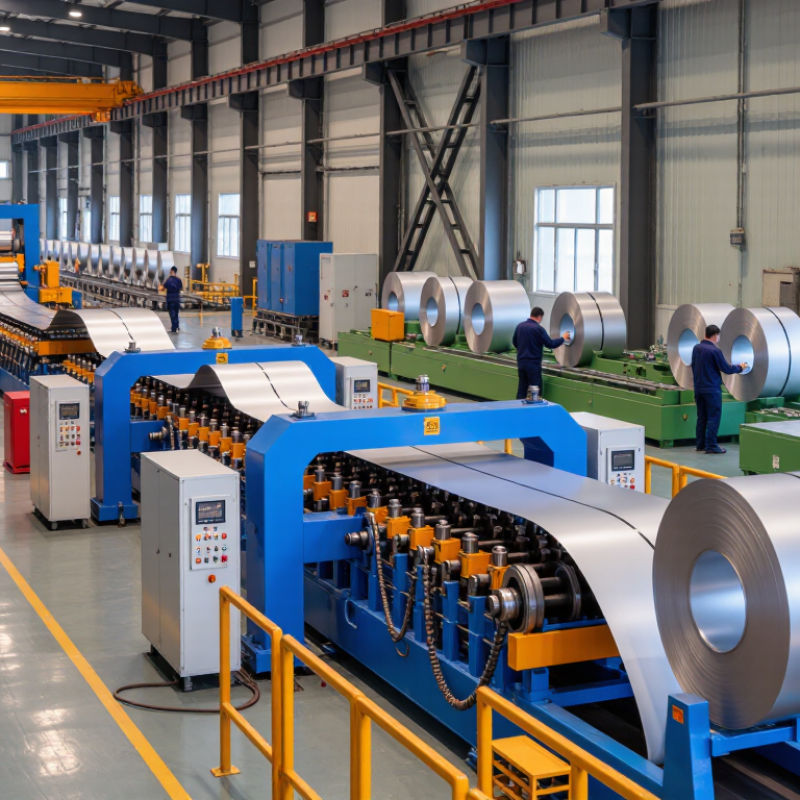
Cold roll forming equipment shapes a continuous strip of metal by passing it through a sequence of rotating roller stations. Each station makes a small bend until the strip reaches the required cross-section. The process typically runs at room temperature, without heating the material. A standard line may include a decoiler, strip guides, forming stands, a drive system, and a cutting unit. The finished profile might be a roof panel, frame section, or structural channel.
The rollers need to match the material thickness and profile design. Incorrect alignment can leave twists, scratches, or uneven edges. Small setup errors matter. Line speed, tooling condition, and strip quality also affect the result. Unlike a press brake, the equipment forms long profiles continuously, which can support steady production. Still, not every shape or production volume suits this method. In practice, the first profile may need adjustment before dimensions stay consistent.
Tips: Check roller alignment and cut length during setup. Ask for sample runs using your actual material, not just drawings. Inspect the profile at several points along its length. A smooth surface can look convincing, but it does not prove that dimensions are accurate. Keep a record of settings; operators sometimes rely too much on memory.
A typical cold roll forming line guides sheet or coil through successive stations to create a continuous profile.
The bars show workflow order only, not time, capacity, or equipment performance. Line configurations vary; cutting may be performed in-line or as a separate operation.
Cold roll forming turns a flat metal strip into a continuous profile without heating it. A decoiler feeds the coil through a leveler, then successive roller stations bend the strip a little at a time. Each station has shaped upper and lower rolls. Together, they gradually create features such as ribs, channels, or raised edges. The World Steel Association reported 1,892.2 million tonnes of crude steel production in 2023, showing the scale of the material industry that supplies many roll-forming lines. That figure does not indicate machine output or product quality.
After forming, a cutting unit separates each piece to the programmed length. A control system coordinates feed speed, roll position, and cut timing. Operators check alignment and dimensions during setup, often using calipers and a sample profile. Small adjustments matter. A slight mismatch between stations can cause twisting, surface marks, or uneven flanges. In practice, coil thickness, yield strength, and lubrication all affect how the strip behaves, so settings for one material may not suit another.
It looks straightforward. It isn’t.
A useful production trial checks the finished section across several lengths, not just one sample. The World Steel Association’s World Steel in Figures 2024 provides the cited production data; actual line capacity depends on profile geometry, material specifications, and changeover time. Even experienced teams can miss springback at first, so record measurements and revise the roll setup before running a long batch.
A leading cold roll forming equipment manufacturer is defined by engineering consistency, not a polished catalogue. The team should explain how roller stations, shaft dimensions, and forming speed suit the customer’s material thickness and profile. Ask to review layout drawings, tooling calculations, and sample parts from a comparable production line. Small details matter.
A factory trial can reveal more than a sales presentation. Check whether the machine feeds coil smoothly, forms the section without visible twisting, and holds dimensions across repeated samples. Ask how measurements are recorded and what happens when a trial misses the agreed tolerance. Clear answers show process control. Vague assurances do not. Also examine weld quality, electrical cabinet labeling, safety guards, and access for routine maintenance.
Reliable manufacturers provide usable documentation, operator training, spare-parts guidance, and responsive technical support after delivery. Confirm the scope in writing, including installation responsibilities and expected response times. A site visit or live video inspection can help verify workshop capacity and assembly practices. Still, no single visit proves future performance. Even capable factories may have weak points, so compare evidence carefully rather than relying on price or export claims alone.
Compare machines against your actual profile, material grade, thickness, and target speed—not catalogue claims. Ask each supplier to run your drawing and coil specification. Measure finished dimensions at several points, including after cutting. A neat sample is useful. A repeatable run is better.
The World Steel Association’s World Steel in Figures 2024 reports that China produced 1,019.1 million tonnes of crude steel in 2023, about 54% of global output. This indicates a large steelmaking base, not that every machine builder can process your material consistently. Ask for test records showing line speed, profile tolerances, changeover time, and scrap rate. Ask for proof.
Inspect the roll tooling and drive system, then check how operators adjust guides and replace worn parts. Request a recorded acceptance test using your product, and clarify what happens if the machine misses agreed tolerances. Verify installation, training, spare-part lead times, and remote support with specific response times. I would treat a polished demonstration video cautiously; it cannot show a full shift of adjustments or material variation. Small details matter. Compare the evidence, not just the price.
Cold roll forming equipment from Chinese manufacturers serves industries that need long, consistent metal profiles. Construction is a major user. Production lines form roof panels, wall studs, purlins, decking, and cable trays from metal coils. These profiles must hold their shape during transport and installation. Small dimensional errors can complicate assembly on site.
Automotive and appliance suppliers use roll forming for rails, brackets, door frames, and cabinet sections. Warehouses need formed uprights and beams for storage racks. Solar projects use mounting channels and support rails, while agricultural equipment makers produce guards and structural sections. The right machine depends on material grade, thickness, coating, and profile complexity—not just line speed. A fast machine can still produce scrap.
Tips: Ask for sample profiles made from your own steel. Check cut length, hole position, roller marks, and changeover time. Request a clear maintenance list. A test run matters.
A line designed for simple roof panels may not suit narrow, high-strength automotive parts. Share drawings, tolerances, coil details, and expected daily output before comparing quotations. Confirm local service access and spare-part lead times, too. This step is often overlooked, but delays can be costly.
| Industry | Common Roll-Formed Products | Typical Material | Typical Equipment or Line Features | Typical Application |
|---|---|---|---|---|
| Construction and building envelope | Roofing and wall panels, purlins, metal studs, tracks, and ceiling channels | Coated or galvanized steel; aluminum for selected panel profiles | Multi-stand forming line, decoiler, cutting unit, and optional punching or stacking equipment | Commercial buildings, warehouses, and light-gauge framing |
| Solar energy structures | Mounting rails, support channels, and structural sections | Galvanized or coated steel; aluminum for some rail designs | Profile-specific tooling, in-line punching, length cutting, and optional automatic handling | Rooftop and ground-mounted photovoltaic systems |
| Automotive and vehicle components | Reinforcement sections, channels, rails, and selected seat or body components | Carbon steel, galvanized steel, and selected high-strength steels | Precision roll-forming stations, controlled feeding, and integrated punching or cutting | Vehicle structures and component assemblies; suitability depends on the part design and material grade |
| Warehousing and storage | Storage-rack uprights, beams, bracing, and shelf sections | Cold-rolled or galvanized steel | Punching and roll forming configured to the profile, followed by cut-to-length and stacking | Pallet racking, shelving, and industrial storage systems |
| Electrical infrastructure | Cable trays, ladder-tray side rails, and support channels | Galvanized steel, stainless steel, or aluminum, depending on the service environment | Forming line with profile-specific rolls and optional hole punching and cutting | Cable management in industrial, commercial, and infrastructure facilities |
| Appliance and equipment manufacturing | Cabinet frames, reinforcement channels, guide rails, and enclosure sections | Cold-rolled or coated steel; aluminum for selected components | Compact or dedicated roll-forming line with controlled feeding and cut-to-length operation | Appliance housings, industrial enclosures, and equipment frames |
| Transportation and trailers | Trailer floor sections, side rails, roof bows, and structural channels | Steel or aluminum, selected according to load, weight, and corrosion requirements | Long-length forming, profile-specific tooling, and cutting or handling equipment | Truck bodies, trailers, and other fabricated transport structures |
Applications and machine configurations vary by profile geometry, material grade, thickness, production speed, and required tolerances. Confirm the specifications against the intended product and operating requirements.
It shapes a continuous metal strip through rotating roller stations. Each station adds a small bend until the strip reaches its required profile. The process usually runs at room temperature. Small setup errors matter.
A standard line may include a decoiler, strip guides, forming stands, a drive system, and a cutting unit. Together, these components can produce long roof panels, frame sections, or structural channels.
Roller alignment, tooling condition, line speed, material thickness, and strip quality all affect the result. Poor setup may cause twists, scratches, uneven edges, or incorrect cut lengths. Looks can mislead.
Review layout drawings, tooling calculations, and sample parts from a comparable line. During a factory trial, watch the coil feed and inspect repeated profiles. Ask how measurements are recorded and how missed tolerances are handled.
Use the customer’s actual material, not drawings alone. Check dimensions at several points, along with surface marks, cut length, and consistency across samples. A test run matters. One short trial still cannot prove long-term performance.
Construction uses roof panels, wall studs, purlins, decking, and cable trays. Automotive and appliance suppliers make rails, brackets, door frames, and cabinet sections. Warehouses, solar projects, and agricultural equipment makers use formed parts too.
Share drawings, tolerances, material grade, thickness, coating, and expected daily output before comparing quotations. A line for simple roof panels may not suit narrow, high-strength parts. A fast line can still produce scrap.
Ask for operator training, usable documentation, spare-parts guidance, and clear technical support response times. Confirm installation responsibilities and local service access in writing. I might trust a polished sample too quickly; it deserves a second look.
Cold Roll Forming Equipment shapes flat metal coils into precise profiles through a series of rollers, gradually forming the material without heating it. The process supports consistent dimensions, smooth finishes, and efficient production. A typical system may include coil handling, feeding, forming stations, cutting, and control components, with its configuration tailored to the required profile and production volume.
When comparing manufacturers in China, consider engineering capability, material quality, production accuracy, machine reliability, customization options, technical support, and delivery expectations. Ask how equipment is tested and whether the manufacturer can provide clear specifications and service guidance. Chinese-made systems are used across industries such as construction, automotive, storage, and electrical manufacturing, where they produce components including panels, frames, channels, and structural profiles. The best choice is the manufacturer whose equipment and support match your application, quality requirements, and long-term production needs.
